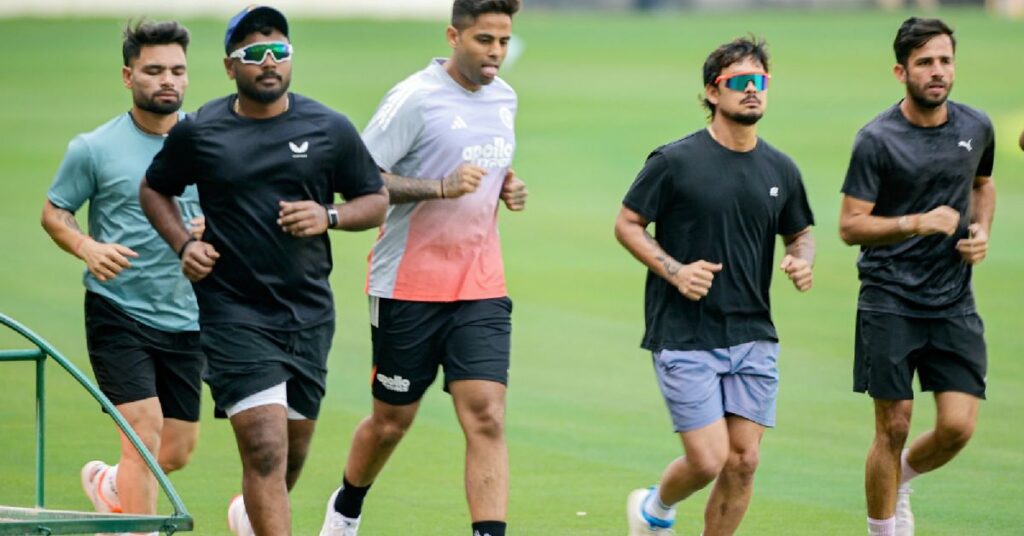

Team India’s preparations for the 1st T20 International against New Zealand have taken a decisive shape, with strong indications emerging around the probable playing XI. According to reports and team management signals, Kuldeep Yadav is set to miss out on a place in the XI, while Ishan Kishan is likely to be promoted to the No. 3 position, a move that underlines India’s evolving T20 strategy ahead of major global tournaments.
As India and New Zealand gear up for another high-intensity bilateral clash, team selection has become the primary talking point. With the T20 format demanding constant evolution, India appears ready to make bold yet calculated calls, prioritising batting depth, flexibility, and match-ups over traditional selections.
This blog provides a detailed breakdown of India’s likely playing XI for the 1st T20I, the reasons behind Kuldeep Yadav’s omission, Ishan Kishan’s role at No. 3, New Zealand’s challenge, and the broader tactical picture.
India vs New Zealand T20I Series: Context and Importance
An India–New Zealand T20 series is never just another bilateral contest. Over the years, New Zealand have emerged as one of the most disciplined and tactically astute teams in world cricket, often challenging India across formats.
For India, this series serves multiple purposes:
- Testing new combinations
- Finalising core players for upcoming ICC events
- Evaluating middle-order stability
- Managing player workloads
The 1st T20I, in particular, sets the tone for the series and often reveals the team management’s long-term vision.
Kuldeep Yadav Set to Miss Out: A Tactical Call, Not a Snub
One of the biggest surprises ahead of the 1st T20I is the expected omission of Kuldeep Yadav, India’s experienced left-arm wrist spinner.
Why Kuldeep May Miss the 1st T20I
Kuldeep’s absence is not necessarily a reflection of poor form. Instead, it appears to be driven by:
- Team balance considerations
- Preference for batting depth
- Match-ups against New Zealand batters
- Conditions favouring pace or finger spin
In T20 cricket, teams often prioritise all-rounders and batting depth over specialist bowlers, especially on batting-friendly surfaces.
India’s Spin Strategy: Flexibility Over Specialisation
India’s spin attack has evolved significantly in recent years. Instead of relying solely on specialist spinners, the team now often prefers:
- Batting all-rounders who can bowl spin
- Finger spinners who offer control
- Match-up based selections
Kuldeep, being a wrist spinner, is most effective when batters attack him. Against New Zealand’s relatively cautious middle order, India may have opted for control rather than risk.
Ishan Kishan at No. 3: A Strategic Promotion
Perhaps the most intriguing development is Ishan Kishan’s expected role at No. 3. Traditionally seen as an opener, Kishan’s promotion signals a shift in India’s batting philosophy.
Why Ishan Kishan at No. 3 Makes Sense
Ishan Kishan brings several advantages to the No. 3 role:
- Left-hand batting option
- Ability to counter spin early
- Natural aggressor against pace
- Experience handling pressure
With openers often setting the tone, the No. 3 batter in modern T20 cricket must be capable of seamless acceleration or consolidation, depending on the situation.
India’s Top Order Blueprint
India’s top order for the 1st T20I is expected to be structured around:
- Explosive starts
- Flexible middle-order transitions
- Avoiding early collapses
Ishan Kishan at No. 3 provides insurance. If an early wicket falls, he can stabilise. If the openers fire, he can attack immediately.
Probable India Playing XI for 1st T20I
Based on current indications, the likely Indian XI could look like this:
- Openers – Aggressive right-left or right-right combination
- Ishan Kishan – No. 3
- Middle-order stabiliser – Captain or senior batter
- Power hitter / finisher
- All-rounder
- Wicketkeeper-finisher (if Kishan is not keeping)
- Bowling all-rounder
- Pace bowler
- Pace bowler
- Spinner or spin-all-rounder
- Pace or variation bowler
This combination ensures batting till No. 8, a hallmark of modern T20 success.
What Kuldeep’s Omission Means for Team Balance
Leaving out a specialist spinner like Kuldeep suggests India wants:
- Extra batting depth
- More pace options
- Greater fielding agility
On smaller grounds or high-scoring venues, wrist spinners can sometimes be expensive. India may be keeping Kuldeep fresh for later matches depending on conditions.
New Zealand Challenge: Why Selection Matters
New Zealand thrive on:
- Discipline
- Exploiting mistakes
- Smart bowling changes
Against such a side, India needs:
- Batters who can rotate strike
- Bowlers who avoid loose deliveries
- Flexible match-ups
Ishan Kishan’s presence at No. 3 allows India to counter New Zealand’s spinners and medium pacers during the middle overs.
Middle-Order Stability: India’s Long-Standing Concern
One of India’s biggest T20 challenges in recent years has been middle-order consistency. Promoting Ishan Kishan could help:
- Reduce pressure on No. 4 and No. 5
- Maintain run rate after powerplay
- Prevent collapses against spin
The move indicates that India is experimenting to find the ideal middle-order template.
What This Means for Kuldeep Yadav Going Forward
Kuldeep Yadav remains a vital part of India’s white-ball plans. His omission from the 1st T20I should be viewed as:
- A rotation decision
- A tactical adjustment
- A conditions-based call
With multiple matches in the series, Kuldeep is likely to feature when surfaces offer more assistance to wrist spin.
Ishan Kishan’s Opportunity to Cement His Role
For Ishan Kishan, batting at No. 3 is a golden opportunity. A strong performance could:
- Secure his place in India’s preferred XI
- Establish him as a multi-role batter
- Increase his value ahead of global tournaments
In modern T20 cricket, adaptability is often valued more than fixed roles.
Fielding and Athleticism: An Added Advantage
Another factor behind India’s selection choices is fielding. Ishan Kishan is an excellent athlete, offering:
- Sharp catching
- Quick reflexes
- Energy on the field
In contrast, balancing specialist bowlers sometimes comes at the cost of fielding depth.
Captain and Management’s Thought Process
India’s team management appears focused on:
- Long-term planning
- Building a flexible squad
- Preparing for different match scenarios
Such decisions indicate a shift from conservative selections to dynamic, situation-based choices.
Fans’ Reaction: Mixed but Curious
Indian fans have reacted with:
- Surprise at Kuldeep’s omission
- Curiosity about Kishan’s new role
- Optimism about batting depth
While some fans favour specialists, others appreciate experimentation in bilaterals.
Key Match-Ups to Watch in the 1st T20I
- Ishan Kishan vs New Zealand spinners
- India’s pace attack vs NZ top order
- Middle-overs control without Kuldeep
- Finishing overs with extended batting depth
These match-ups will determine whether India’s selection gamble pays off.
Why the 1st T20I Is Crucial
The opening match often:
- Sets momentum
- Reveals team balance
- Influences selections for the rest of the series
A successful outing without Kuldeep could reinforce India’s strategy, while struggles may prompt quick changes.
Looking Ahead: Rotation and Adaptability
India is expected to rotate players through the series, meaning:
- Kuldeep could return in later matches
- Batting positions may still be tweaked
- Bowling combinations could vary
The focus remains on finding the most effective XI for big tournaments, not just winning one match.
Conclusion: A Bold but Thoughtful India XI
The expected playing XI for the India vs New Zealand 1st T20I, with Kuldeep Yadav set to miss out and Ishan Kishan promoted to No. 3, reflects India’s willingness to evolve with the modern T20 game.
Rather than sticking rigidly to specialists, India is exploring flexibility, depth, and adaptability—qualities essential for success at the highest level.
As the match unfolds, all eyes will be on Ishan Kishan’s performance in his new role and how India manages the middle overs without Kuldeep’s wrist spin. Whether this combination succeeds or not, one thing is clear: India is not afraid to experiment—and that could be their biggest strength moving forward.